Showing posts with label George Kline. Show all posts

Thursday, June 12, 2014

Hog Roundup 1931

According to the Encyclopedia of Arkansas History & Culture, folks in Arkansas have the Spanish explorer Hernando de Soto to thank for bringing swine to Arkansas in 1541.  Their offspring remain throughout the state today.  While in the 1930s they served, in both their wild and domesticated varieties, as a welcomed source of protein for folks in Crockett's Bluff, today they have in their feral form become a statewide nuisance and enemy of the general natural environment.

Among several rare photographs passed along to me some time ago by Hallie Keithley - still to this date the oldest current resident of the Bluff -  reflect life in the 1930s generally and more specifically life on the River. 

The image below is especially rare and historically interesting for both the subjects in the fore and background.  Thanks to the notes neatly inscribed on the back of the picture by Flavelia (Bela) Kline, both the husband of one of the figures in what appears to be a make-shift barge and for most of the years of my youth the post mistress from a room in the Kline house.  

George and John Kline are returning from the final day of the wild hog roundup in 1931:   "Geo and John Kline leaving Monroe Co. on the last day of the hog round up, Jan. 15, 1931.  The Steamer Robert H. Romander(?) coming up the river with 2 barges of logs 200,000 ft.  It took her 15 min to make Crockett's Bluff Bend in White River."

The Kline Brothers


Charlie McDonald's House Boat
Excellent image of what appears to be two houseboats abutting each other.  Although Charlie McDonald was not someone I remember, his name was frequently mentioned in the Woodiel household.  Could the boy in what appears to be "cowboy" attire be his son Gus, pictured elsewhere on this site hanging from the water tower as a young boy who would later loose one of his legs in World War II.  "Im sure this picture was taken down at Mattox Bay because that's where the McDonalds tied up all the time."- Hallie Keithley

CC:Riley Pool, Geo. Kline, Emmet Yokem, Chas. McDonald and ?
Then names in the caption are from Hallie's notes.  Only George Kline (all white in center background) I can positively identify because he gave me my first job working with him in his cotton field west of the Bluff near Voss Lake.  The scene is a shady spot down on the nearest bank to the water on the White River.  Why do I assume it's Sunday or a holiday.  The white shirts and Mr. Pool's necktie, I guess.  Must be early spring, because the water's "up" with little bank showing.

Friday, May 17, 2013

Diving For Shells: Watching for Steamboats


Among the most engaging scenes of the newly released film Mud are several brief episodes in which the character Galen (Michael Shannon) dons an elaborate diving helmet to gather shells or mollusk from the bottom of the White River.  His assistant, a young boy in his early teens named Neckbone (Jacob Lofland) remains alert on the small barge  watching over the air pump and remaining ready to respond to any emergencies or to Galen's signals via a rope to which he is attached.

Because Michael Shannon is known for his portrayal of various crazed characters, any viewer familiar with his roles immediately assumes in him more than a touch of evil.  However, like a number of other false leads in Mud, this is not Galen's role.  In fact, he turns out to be more of a friendly adviser and coach for both the young boys featured in the film, Ellis (Tye Sheridan) and Neckbone.  


Instead, the diving scenes are not the source of terrible danger and potential tragedy, as one naturally expects, but rather in the darkness of the depths could well serve as a metaphor or otherwise enhance the tone of the emerging journey of the boys through their encounters with Mud (Matthew McConaughey)  from the darkness or innocence of childhood into the clear though often harsh realities of the adult world.


DPW Eighth Grade
These scenes, however, were especially engaging for me because on this same White River -- perhaps not far from where much of this film was shot -- during the summer of 1948 or '49 when I was about his age I played Neckbone's role for real while employed by a courageous young Navy veteran newly returned from World War II named O.V. Gosnell. 

 I was that boy who sat on the anchored barge and waited, watching for steamboats and trying to stay alert for any emergency.  If the engine stalled that pumped air down the garden hose to O.V.'s cleverly jerry-rigged helmet, I was prepared to turn the fly wheel of our jerry-rigged engine until he had time to surface so I could hook the top of his helmet to a ring on the back of the barge.  If the occasional steamboat did appear, its whistle could be heard far down beyond the next bend of the river, my signal to pass along to O.V. via a prescribed number of tugs on the rope, the under end of which was around his waist on the bottom of the river.

O.V. Gosnell Eighth Grade

The barge and engine and diving gear of the film, in contrast to ours, are, of course, "hollywood" in every detail, the helmet complete with glass viewing area and even lights, the engine air pump painted and efficient, unlike ours.  Those pictured below in a National Geographic stock image of a diver on the Mississippi River are closer to ours in most details -- the weighted helmet made from a galvanized can and the the net used to collect the shells gathered; only here a hand operated air pump.

Summer jobs around the Bluff that were to be had in the late 1940s and '50s were almost exclusively associated with the farms that extended in vast flat prairies to the south and west of the wooded hamlet that extended along the bend of the River that was home to the post office located in the home of Bealah and George Kline, the Baptist Church that lay at the entrance to the cemetery, and Schwab's Store, the clear center of all important activity, save perhaps on Sunday morning.  So, a job of any kind on the river was unique.

My only previous paying job, before O.V. lured me away with a  promise of the hefty salary of fifty-cents per hour, had been one plowing cotton middles behind a hefty buck skinned horse from sun-up to sun down for $2.50 per day for Mr. George Kline in his lone cotton field some two miles westward out the Hill Road.  We road his horses Lightning and Buck back and forth from our work.

Because O.V. was only able to work beneath the surface of the White River for only a few hours each morning and afternoon, my salary was probably about the same as the one ridding the cotton field middles of their grass and weeds, but it allowed me more time to wander about during the rest of the summer and to hang out at Schwab's Store, where the action was, listening to the stories of travelling salesmen and a random collection of bored and non-working farmers.  The human interaction was what I relished.  For shear isolation, following a horse behind a plow all day, or for that matter riding a tractor all day in two mile laps is to be rated right up there with the legendary lonesome cowboy and his horse riding the range endlessly. 

 The sweltering heat on a barge on a river in summer ( for some reason, an umbrella or even a make-shift were never considered) is hardly an ideal working environment, but it was a welcomed change from work in the fields.

I spent most of my earnings that summer on the purchase of a used bicycle from the Western Auto Store in DeWitt.  It had been newly painted red.  I rode the gravel roads for miles around, and I recall one spill on loose gravel at the bottom of the hill toward the river landing near the Herman Marrs house.  Both knees skinned for a week. 

I remember O.V. as being very supportive of me as a boy, perhaps because he didn't treat me as a boy.   I admired him and was amazed by his abilities and ambitions.  He realized if he could condition himself to descend to the depths of the river he could gather more shells in an hour that those using the conventional "crows feet" method of dragging the bottom from the surface of the water could gather in a long day, or longer.  So, that summer remains a great memory for me.


For some time, as I recall, I begged him to let me give diving a try until one day he consented. At the end of the day, we ventured up around the bend above the Bluff to a sand bar and I gave it a try. I donned the helmet and waded outward.  I doubt I got down more than about ten or twelve feet or so before I sensed my head was about to blow off, and I had to abandoned the venture.  Characteristically, there was not the least hint at teasing me as I rose and removed the helmet. He just said: "Well, you just have go down far enough for your ears to pop; it's easy from that point on.


Footnotes

During the depression years, the button industry thrived on the Arkansas Rivers including the Mississippi.  More on this topic later.


Thursday, May 17, 2012

Two Childhood Memories for a Grandson

Here are two childhood memories written for my grandson Griffin Bliss for a project related to Lois Lowry's novel The Giver in his seventh grade English class at St. Andrews School at Savannah, Georgia. 

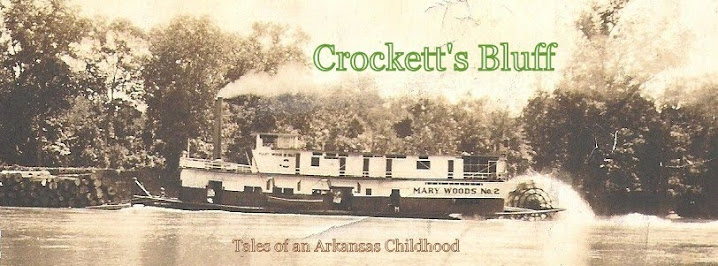
The first is about my first job at about his age plowing cotton for Mr. George Kline in his field out the Hill Road just west of Voss Lake.  The second is a recollection of the recurrent thrill of all Bluff children at the sound of the whistle of the Mary Woods No. 2

About Your Age 

When I was about your age, a sixth or seventh grader, I was offered my first real paying job.  Something more than the familiar string of unpaid chores assigned to all boys that age who lived on farms in rural Arkansas in the late 1940s.

It was a relatively simple job working on a small cotton farm owned by Mr. George Kline, one of our neighbors in Crockett’s Bluff, a small community at the bend of the White River where I was born and grew up. 

The downside of this job was that I was required to be at his house shortly after sunrise in the morning, not to return until the sun was setting in the evening, a long day.  But the upside was that I was paid what was to me a hefty sum of $2.50 per day.

Since the field where we worked was almost two miles from his house, we rode the horses back and forth each day we would be using in our labors.

 I was required simply to stabilize a plow, pulled by a great buckskin horse appropriately named “Buck,” up and down between the rows of cotton plants uprooting any grass or weeds that might be there.  Mr. Kline came along behind me down these rows with another smaller and more precise plow – pulled by his favorite horse “Lightning” -- that loosened the soil and “cultivated” the plants in their early stages of growth. 

Buck was an enormous so-called “draft” horse, bred for hard and heavy work, and his strength appeared to me to be unlimited.  So, any thought that I, at less than a hundred pounds, was supposed to control his starting, turning, and stopping movements with the reins I leaned into from time to time tied behind my back, was a joke.  Consequently, Buck stopped and turned whenever he pleased, much to my enormous frustration.  

Consequently, since I never gave up trying to control him, from time to time over those sweltering summer days I suffered the modest shame and embarrassment of being gently chastised by Mr. Kline about the quality of the language I addressed to poor old Buck. 

It was a long summer and the work was hard and long and generally hot.  But it was work of the sort one got paid for, and I spent the first twelve dollars I earned on a used red bike with characteristic balloon tires at the Western Auto Store in DeWitt, the county seat of Arkansas County Arkansas. 

 As I rode it for miles over the graveled roads leading in and out of Crockett’s Bluff I felt –what with a paying job – a new sense of what I would now call liberation. 

 *********

The image of an unknown photographer from a Woodiel family album and title image for this site.

The Mary Woods No. 2

The photograph of  the paddle-wheel steamboat pictured above was made from the bank of the White River no more than two hundred yards or so from where I was born in Crockett’s Bluff,  Arkansas, a village in the 1930s much smaller and even more “quiet” and “tired” than the Macomb that Harper Lee describes in To Kill a Mockingbird.  

So, when the steam-whistle of the Mary Woods No. 2 was sounded, everyone, particularly children, dropped everything and headed for the bluff banks overlooking the river. 

 Its sound could be heard long before its barge of logs nosed slowly around the bend beneath the red clay bluffs for which the village was named.  We knew we were in for a treat, something truly awesome to us.  She was majestic: grand and powerful enough to move upstream a barge stacked with logs larger than anyone ever viewed elsewhere.  And she made all the noise necessary to justify her presence, the sound of her engines, the splashing patter of her enormous rear wheel, and the usual additional whistle as a special treat to us from the pilot on the bridge who always returned our waves.

The experience was necessarily brief, since even though she moved slowly when compared with the familiar out-board powered fishing boats, a full view was limited to a panoramic minute or two, so it was necessary to run barefoot down along the bank for the next clear opening with a view.

Then, when she was gone from view and rounding the next bend near the familiar sandbar, her super gigantic waves having reached the shore making the house boats bounce like buoys, we were left with the image above, the Mary Woods with the steam from its twin stacks streaming along its back downstream as it forged upriver its massive barge of freshly cut timber.

A scene that is in memory almost as alive now as it was then – a lingering sensual feast in the midst of an otherwise long,  slow and quiet summer day in a “tired” little hamlet at the bend of the White River.

At the viewing site with my sister Maureen Shireman.