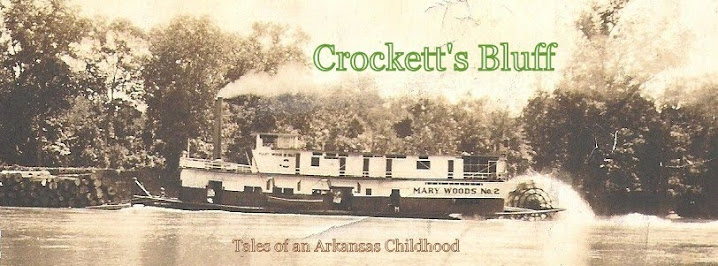

The following is an excerpt from a memoir (or as he prefers to call it, a "remembrance") written by David B. Prange who was born in Crocketts Bluff in 1926 and lived there until his family moved to California in 1944. For copies of his Crocketts Bluff As I Remember It contact David B. Prange, 16471 E. 196th St., Noblesville, IN 46060.
"Crocketts Bluff is the northern gateway to the White River Prairie. This prairie that is a vast plain of fertile soil was then, and still is, comprised of thousands of acres of cultivated farmland, mostly dedicated to growing rice.
There were then, and still are, only two roads into the Bluff. One from the south and the other from the west. As it was, in my earliest memories, the road from the south was  graveled and was maintained by the county. The road from the west, referred to by the natives as the Hill Road, was dirt and was not maintained.
 graveled and was maintained by the county. The road from the west, referred to by the natives as the Hill Road, was dirt and was not maintained.
 The Hill Road designation was not due to having been named for the Hill family, which was in residence there, but because within the first one-half mile, upon leaving the Bluff, three hills were encountered which were uniformally situated and almost equal in the height of about fifty feet. To navigate the Hill Road during and immediately after a rain was a very real challenge because it was comprised of red clay. At a later time, during the Great Depression, the WPA graded the road to be more level, after which they surfaced it with loose gravel.
Before the Hill Road improvement, Crocketts Bluff was considered to be at the end of the road, and it truly was, considering the fact that the Hill Road was extremely primitive." [Further excerpts re the Prange water tank, the Crocketts Bluff School, the Prange, Schwab, and Inman stores, and the excitement of White River steamboats will follow.]


